
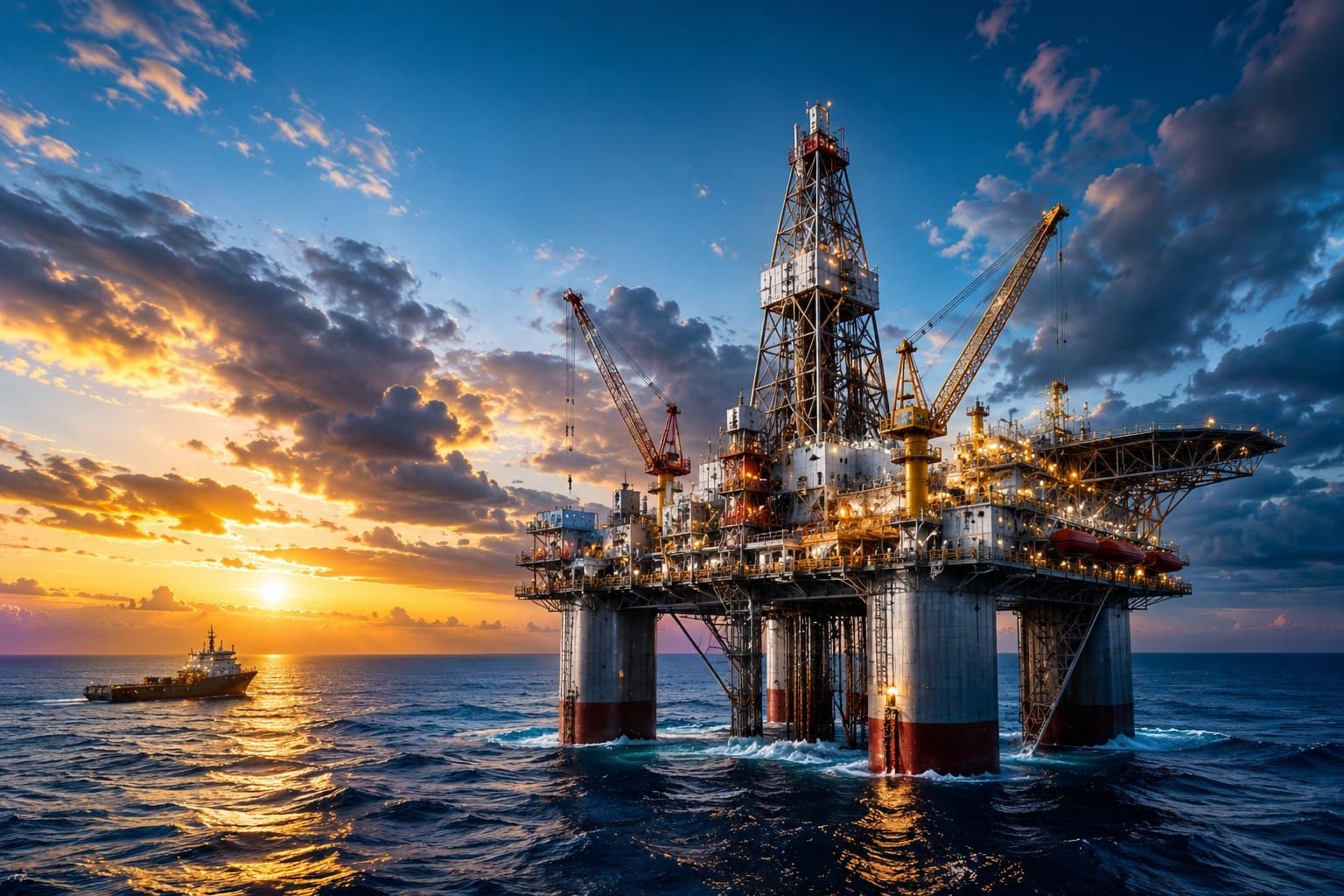
🛢️ India imports roughly 85% of the crude oil it consumes.
That bill runs into trillions every year. It is the single biggest drag on India’s current account. Every dollar of crude bought abroad is capital that did not build something at home.
Everyone watches the import number. But almost nobody watches what lies beneath Indian waters.
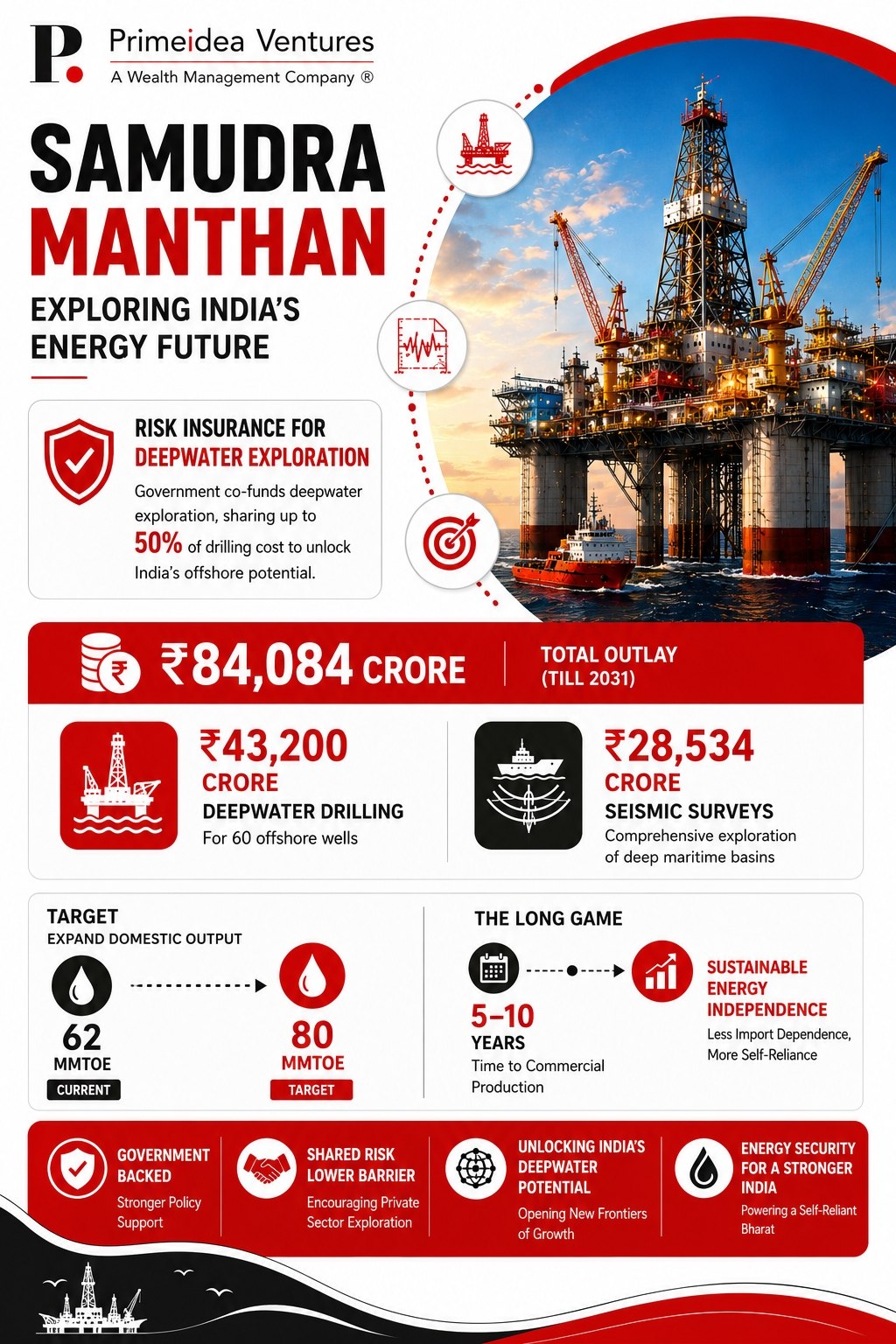
🌊 On 31 July 2026, the Union Cabinet approved the Samudra Manthan – National Offshore Exploration Scheme. Phase-I runs through FY 2030–31. The outlay is ₹84,084 crore.
The name is not random. Samudra Manthan — the churning of the ocean. The mythology is about gods and demons churning the ocean for amrita, the nectar of immortality. The policy version is about churning the seabed for hydrocarbons. The nectar, in this case, is energy self-reliance.
Why does this matter?
Because India has already awarded 172 offshore blocks under the Open Acreage Licensing Programme (OALP), covering roughly 3.8 lakh sq. km. Committed investments exceed $4.3 billion. And on 25 July 2026 — six days before the Cabinet approval — drilling commenced on the MN-DWN18-1-HD appraisal well in the Mahanadi deepwater basin.
The story moved from “policy intent” to “drilling started.” That is a different story.
🧐 The Government Is Absorbing the Geological Risk
The government is not just funding exploration. It is absorbing the geological risk.
Deepwater drilling is binary. You either hit hydrocarbons or you hit a dry hole. A single ultra-deepwater well can cost ₹1,000+ crore. If it comes up dry, that money is gone. No revenue, no return, no recovery.
This is why private operators do not drill deepwater frontier basins on their own. The risk is too concentrated. The timeline is too long. The capital is too heavy.
So the government is stepping in with a simple mechanism:
- ₹43,200 crore to co-fund 60 deepwater and ultra-deepwater wells.
- The government covers up to 50% of exploration costs.
- Cap: ₹675 crore per well.
🤔 Think about what that means.
The operator still carries risk — half the cost of a dry well is still a painful number. But the government has cut the downside in half. It has converted “binary bet your company” into “shared bet with the sovereign.”
That changes the math for every upstream player with offshore acreage. Frontier basins that were commercially unviable yesterday become drillable today.
📡 The Second Tap: Seismic Data
₹28,534 crore for seismic data acquisition and processing.
This is the part that creates immediate revenue visibility — not in 10 years, but now.
Before you drill, you map. High-resolution 2D and 3D seismic surveys are the geological equivalent of an X-ray. You send acoustic waves into the seabed, measure what bounces back, and build a 3D picture of what is underneath.
This money flows straight to seismic survey companies, geophysical data processors, and offshore service providers. It is the picks-and-shovels layer of the offshore boom. The drilling may take a decade to monetize. The seismic contracts monetize in months.
The mechanism matters. The government is not just paying for holes in the ground. It is paying for the map first, then the drill.
🏗️ The Third Tap: Shared Infrastructure
- ₹10,000 crore for common offshore infrastructure hubs.
- ₹2,000 crore for domestic oilfield manufacturing and service clusters.
Here is why this is not a small distinction.
Offshore exploration has a chicken-and-egg problem. Operators need infrastructure — supply bases, pipeline landfall points, fabrication yards, repair docks — to operate efficiently. But nobody builds that infrastructure until there is enough exploration activity to justify it. And exploration does not happen at scale until the infrastructure exists.
The government is breaking the deadlock by building the shared layer first.
This is the same playbook India used in roads, ports, and telecom. Build the common infrastructure, lower the entry barrier, let private capital fill in behind.
🎯 The Targets Are Not Small
- Discover 600+ MMTOE of hydrocarbon reserves.
- Increase domestic production from ~62 MMTOE to ~80 MMTOE.
- Reduce annual crude import bill by ~₹1 lakh crore.
To put 600 MMTOE in context — that is roughly 12 years of India’s current domestic production, sitting undiscovered under Indian waters.
The scale of intent is what should grab you. This is not a pilot. It is not a feasibility study. It is a ₹84,084 crore commitment with a 5-year Phase-I horizon and drilling already underway.
⚠️ Here Is the Catch
Deepwater exploration carries binary geological risk. Dry wells absorb non-productive capital despite the government’s risk-sharing mechanism. The government may cover 50%, but 50% of a ₹1,000 crore dry hole is still ₹500 crore of public money into a hole with nothing in it.
⏱️ And the timeline is the real enemy.
Offshore discoveries typically take 5 to 10 years to reach commercial production. A well drilled in 2027 might produce first oil in 2033 — if it finds anything at all. In that gap, the project sits exposed to global crude price volatility, vessel availability bottlenecks, monsoon disruptions, and policy continuity risk.
A new government in 2029 could look at dry holes and rethink the whole programme. That is the execution risk nobody can underwrite.
And standalone pure-play downstream refiners — companies that refine crude but do not produce it — gain nothing from this. Their margins depend on crude being available and affordable. Domestic offshore production, even if it succeeds, will take a decade to move the supply needle. The refiners are not the beneficiaries here. The upstream and offshore services chain is.
🏗️⚓ So Who Actually Benefits?
The value chain is layered. Each layer monetizes on a different timeline.
Layer 1 — Seismic and survey (immediate): Companies providing 2D/3D seismic data acquisition and geophysical surveys. The ₹28,534 crore outlay creates direct contracting opportunity. This is the fastest money in the entire scheme.
- Asian Energy Services and Alphageo — pure-play seismic survey providers.
- ONGC and Oil India — the state upstream majors who will both commission and consume seismic data.
Layer 2 — Drilling and upstream (medium-term): Companies that own drilling rigs and operate offshore wells.
- ONGC — India’s largest upstream producer and the primary direct beneficiary of government risk-sharing in deepwater exploration.
- Reliance Industries — pioneer in deepwater and ultra-deepwater operations (KG-D6 basin), with the capital scale and subsea infrastructure to participate in new offshore block allocations.
- Vedanta (Cairn Oil & Gas) — major private exploration entity with extensive offshore acreage in Cambay and KG basins.
- Jindal Drilling — pure-play offshore jack-up rig operator under long-term charter contracts.
- Hindustan Oil Exploration — focused independent upstream producer operating offshore marginal fields.
Layer 3 — Offshore EPC and fabrication (medium-term): Companies that build the platforms, jackets, subsea structures, and pipelines.
- Larsen & Toubro — dominant offshore EPC player via L&T Energy Hydrocarbon division. Prime contender for building offshore platforms, process modules, and subsea pipelines.
- Mazagon Dock Shipbuilders — advanced marine fabrication capabilities for offshore platforms and subsea structures.
- Cochin Shipyard — key builder of offshore support vessels (OSVs) and platform supply vessels (PSVs).
- Garden Reach Shipbuilders — proven capability in specialized marine survey vessels and offshore logistics support ships.
Layer 4 — Subsea pipes and equipment (medium-term):
- Welspun Corp — global market leader in high-grade subsea and offshore large-diameter steel line pipes.
- Ratnamani Metals & Tubes — critical supplier of seamless stainless steel and carbon steel casing, tubing, and instrumentation pipes for high-pressure offshore wells.
Layer 5 — Offshore logistics and services (continuous):
- Great Eastern Shipping — substantial offshore division providing anchor handling tug supply vessels and platform supply vessels to drilling sites.
- Seamec Ltd — operates a dedicated fleet of diving support vessels for subsea inspection, maintenance, repair, and construction.
- Deep Industries — specialized oilfield services with capabilities in offshore gas compression, gas dehydration, and workover operations.
Layer 6 — Engineering and consultancy (medium-term):
- Engineers India — premier state engineering and PMC consultant for complex offshore structural design, subsea engineering, and offshore processing terminals.
- Swan Energy — infrastructure exposure to offshore floating regasification units (FSRU), marine heavy fabrication, and offshore energy terminal support.
Layer 7 — Gas evacuation and integration (long-term):
- GAIL (India) — core beneficiary for downstream evacuation. Will construct and operate landfall infrastructure, subsea trunk lines, and gas integration networks.
- Oil India — aggressively expanding offshore footprint, already drilling in the Mahanadi deepwater basin.
💰 The Mutual Fund Route
For investors watching this theme, the mutual fund route matters too.
Three funds stand out for direct exposure:
- Tata Resources & Energy Fund (Sectoral/Thematic – Energy, AUM >₹500 Cr) — delivers direct portfolio exposure to upstream exploration leaders (ONGC, OIL) and primary energy value chain beneficiaries.
- DSP Natural Resources and New Energy Fund (Thematic – Natural Resources, AUM >₹500 Cr) — strong structural mandate covering heavy upstream hydrocarbons, pipeline infrastructure, and industrial engineering enablers.
- Nippon India Power & Infra Fund (Thematic – Infrastructure, AUM >₹500 Cr) — substantial exposure to large-scale capital goods, offshore engineering giants like L&T, and maritime infrastructure suppliers.
These are not recommendations. They are the vehicles. The underlying exposure is what matters — and the underlying exposure is upstream E&P, offshore EPC, and energy infrastructure.
🔮 Where Does This Go From Here?
The story has three acts.
Act 1 — Mapping and drilling (2026-2029): Seismic contracts flow. Drilling begins on allocated blocks. Some wells hit. Some do not. The market will react to discovery announcements, not production — because production is still years away.
Act 2 — Appraisal and development (2029-2032): Successful wells get appraised. Field development plans get approved. Platform fabrication contracts flow to EPC players. Subsea pipeline orders hit the pipe manufacturers. This is where the supply chain multiplier kicks in.
Act 3 — Production and monetization (2032+): First oil and first gas from Samudra Manthan discoveries. If the 600+ MMTOE reserve target is met, domestic production moves toward 80 MMTOE. The import bill shrinks. The current account improves.
But Act 3 is 7+ years away. The market will price Acts 1 and 2 long before Act 3 arrives.
🤷♂️ The Real Question
India’s energy security story has always been “reduce imports.” Every government has said it. Few have backed it with ₹84,084 crore and a 50% drilling subsidy.
The mechanism is sound. The capital is committed. The drilling has started.
But the outcome depends on geology — and geology does not respond to policy intent. You can write the best policy in the world, allocate the best capital, and still hit dry holes. That is the nature of exploration.
The government has decided to take that risk. The private sector does not have to. It just has to show up with the other 50%.
The story moved from “import dependence” to “explore what lies beneath our seas.”
Whether it becomes “energy security” or just “an expensive drilling programme” — that will be decided under the ocean floor, not in the Cabinet room.
🌊 Crazy, right!
What Primeidea Ventures Does
🤝 Primeidea Ventures provides research-driven portfolio strategies for investors looking to participate in India’s energy security theme.
From upstream exploration beneficiaries to offshore EPC and infrastructure plays — we help you identify where the real value lies in this multi-year theme.
Connect with Primeidea Ventures to explore energy sector investment opportunities.