






Nominee or Legal Heir: Who Actually Gets Your Assets?
⚠️ People are treating a nominee and a legal heir as the same thing.
They are not.
A nomination is a custodial arrangement. It tells the bank, the mutual fund, or the insurance company who should hold the asset after death. It does not decide who owns it.
A will does.
📌 And that distinction is where most Indian families discover, too late, that they got the wrong end of the stick.
Here is what most people do. They fill in a nominee form when opening a bank account. They name a nominee in their mutual fund folio. They nominate someone on their insurance policy. And then they think the job is done.
It is not.
⚖️ The Supreme Court settled this in December 2023. In Shakti Yezdani vs Jayanand Salgaonkar, the Court held that nomination does not give the nominee absolute title over the asset. The nominee is a trustee. The legal heirs — or the beneficiaries named in a will — have the real claim.
Not a matter of opinion. Settled law.
The Moneycontrol report from July 30, 2026 put it plainly: “Many people think that once the individual has been nominated as the owner in the Will, he or she automatically becomes the owner of the asset. However, most of the time, the role of a nominee is that of a trustee or custodian of that asset.”
The nominee form you filled in ten years ago? That form does not have the final word.

“My son is a nominee on all my assets. What is the need of a Will then?”
— As per the Law, a nominee is just a caretaker or custodian of assets after someone’s death. They are not the legal owners. They have to distribute the asset amongst all legal heirs, which if not done, can result in a civil suit in Court.
That is the first misconception. And it is the most dangerous one.
What Happens When There Is No Will
🚫 Here is the catch.
Without a will, other legal heirs can challenge the nominee’s claim. And in India, they often do.
That means delays. Court notices. Family disputes. Bank accounts frozen for months. Mutual fund redemptions blocked. Property transfers stuck. All of it landing on the family at the worst possible time — right after someone has died.
The Moneycontrol report notes: “In the case of an existing valid Will, the distribution of the assets is done based on the terms stated in the Will. Hence, there should be no assumption made by heirs that the nominee and the beneficiary will be the same person.”
So the nominee you carefully selected? Without a will, that nomination is a temporary holding arrangement — not a final transfer of ownership.
“I will do it after my retirement.”
— Unfortunately, we humans don’t come with a “Date of Expiry”. Which is why we also purchase Life Insurance — so that the family is protected in case of an untimely death. Making a Will is very similar.
👀 Everyone watches the nominee column in the form. Almost nobody watches the absence of a registered will.
That is the real issue.
Which Law Applies When There Is No Will
🏛️ Here is something most people do not realise.
When there is no will, the distribution of your assets is governed by your religion. Not by one uniform civil code. Not by what you thought was fair. By the personal law applicable to your faith.
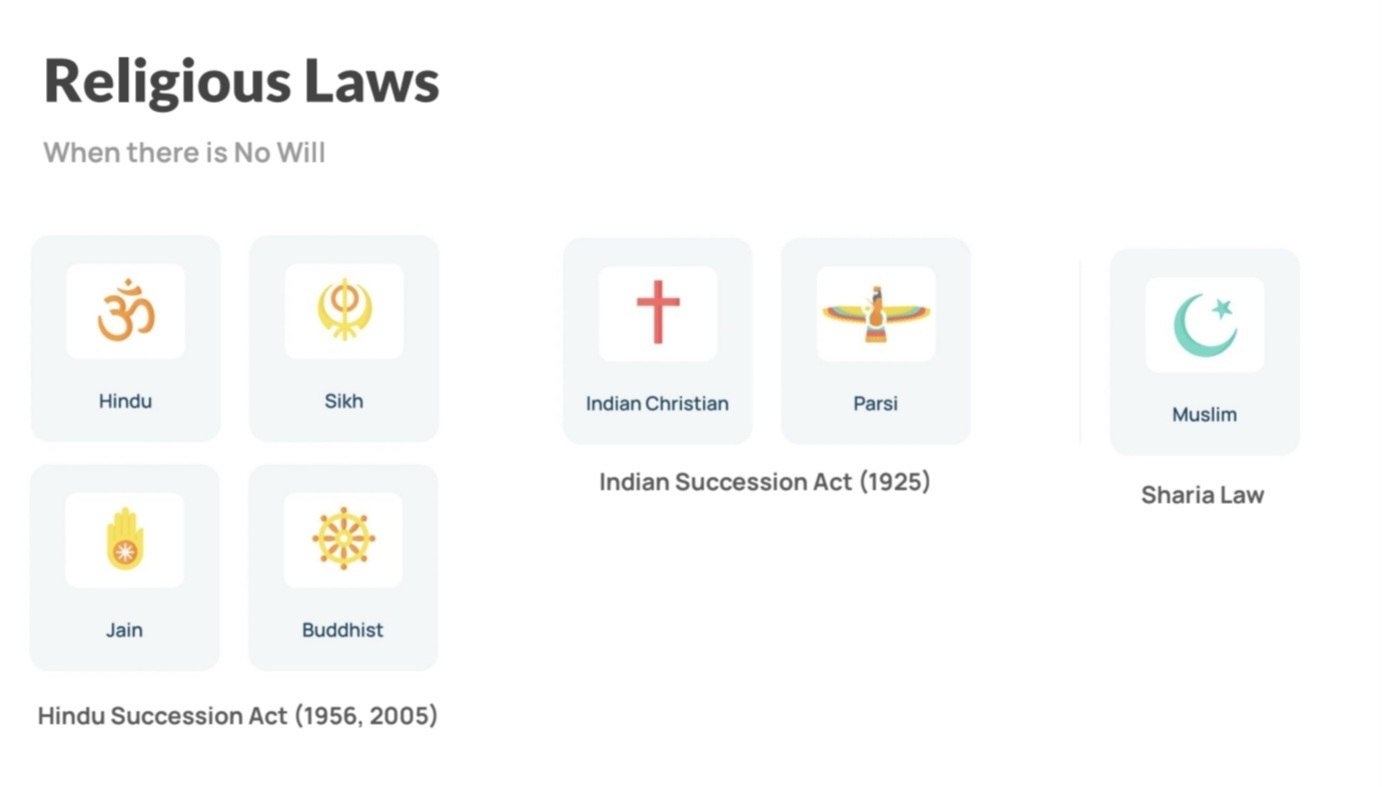
For Hindus, Sikhs, Jains, and Buddhists — the Hindu Succession Act, 1956 (amended 2005). For Indian Christians and Parsis — the Indian Succession Act, 1925. For Muslims — Sharia law.
Each law has its own classification of legal heirs, its own order of priority, and its own rules for asset distribution. If you die without a will, you do not choose who gets what. The law does. And the law’s version of fair may not match yours.
Under Hindu law, for a male, Class 1 heirs include the mother, wife, and children. Class 2 heirs include the father and siblings. If no Class 1 or Class 2 heirs exist, the property goes to agnates and then cognates. For a female, the hierarchy shifts — husband and children first, then in-laws, then her own parents.
One law. Multiple interpretations. Different outcomes for men and women. All decided by statute, not by you.
The Tax Angle: What Is Free and What Is Not
💰 Now comes the tax question. This is where the confusion gets worse.
India has no inheritance tax. It was abolished in 1985. No estate duty. No gift tax on property received through a will or succession. Section 56(2)(x) of the Income Tax Act explicitly exempts inherited assets from taxation at the point of receipt.
So far so good. You inherit, you do not pay tax on the inheritance.
🔍 But here is the interesting bit.
The inheritance itself is tax-free. The moment you sell an inherited asset, capital gains tax applies. The cost of acquisition for calculating capital gains is the cost the original owner paid — not the market value at the time of inheritance.
If your father bought a flat for ₹5 lakh in 1995 and you inherit it and sell it for ₹2 crore, the capital gains calculation uses ₹5 lakh as the base (with indexation benefits depending on the date of transfer).
Income from inherited assets — rent from an inherited property, dividends from inherited shares, interest from inherited fixed deposits — is taxable in the hands of the heir from the date of inheritance.
The inheritance is free. The income is not.
⚠️ That is not a small distinction. Families often discover this only after they have already spent the corpus.
Probate: No Longer Mandatory, Still Recommended
📋 Now, the part that catches people off guard. Probate.
For decades, if you lived in Mumbai, Chennai, or Kolkata, probate was mandatory. Section 213 of the Indian Succession Act, 1925 required it. No probate, no transfer. That meant a court process, months of waiting, and legal fees — even when nobody was disputing the will.
✅ That changed in December 2025.
The Repealing and Amending Act, 2025 omitted Section 213. Probate is no longer mandatory — even in the three metros where it was previously compulsory.
This is a real shift. The mechanism that used to block families for months has been removed.
⚠️ But — and this is the catch — probate is still advisable when there are family conflicts, doubts about the will’s validity, or substantial assets involved. Some institutions may still ask for it voluntarily. The Moneycontrol report confirms: “Probate is needed especially if there are conflicts within the family, doubts on the validity of the Will, or substantial assets are involved.”
Mandatory? No. Recommended in disputed cases? Yes.
That changes the story. But it does not change the fundamentals.
The Excuses People Make
🤔 Most people do not avoid writing a will because they understand the risk and choose to ignore it. They avoid it because they tell themselves a story.
“I don’t have a lot of money. I am middle class.”
— Making a Will is not just for the rich and super-rich. 70% of property-related cases in Court are inheritance-related — across smaller villages and towns.
The numbers say otherwise. Inheritance disputes are not a rich-family problem. They are a middle-class problem. They happen in flats and shops and bank accounts, not just in large estates and family businesses.
“I have a single child. She will anyways inherit everything.”
— A Will acts as a repository of all your assets, so your single child does not have to play treasure hunt in your absence. This is especially helpful when the child is a minor or living separately without much information.
🗂️ A will is not just about who gets what. It is also about listing what exists. Many families discover assets years after a parent’s death — a forgotten fixed deposit, an old insurance policy, a piece of land nobody knew about. A will prevents that treasure hunt.
“We hold everything in joint name. So everything will pass on automatically.”
— Distribution of the deceased person’s share in the asset (even if in Joint Name) is done as per religious laws like Hindu Succession Law, Sharia Law, or Indian Succession Act.
🚫 Joint ownership does not bypass inheritance law. The deceased’s share still gets distributed according to the applicable succession law. The “joint name” assumption is one of the most dangerous ones.
“My Financial Advisor / CA knows everything. He will take care.”
— No Financial Advisor knows 100% of the wealth owned by an individual. Also, inheritance processes are not their expertise — so they cannot guide families on exact steps to be taken if there is no Will or Succession Plan in place.
Your CA files your returns. Your advisor manages your portfolio. Neither of them is an expert in succession law. Neither of them will be the one standing in court when your family is fighting over your assets.
“I will have to submit lot of documents. I have no time to go to Court.”
— Making a Will today does not require visits to Court or a Lawyer’s office. It can be done from the comfort of your home, without paperwork to be submitted. It can be done as quickly as 30 minutes.
✅ The process is simpler than the problem it solves.
What Goes Into a Valid Will
📝 Here is what a will actually needs.
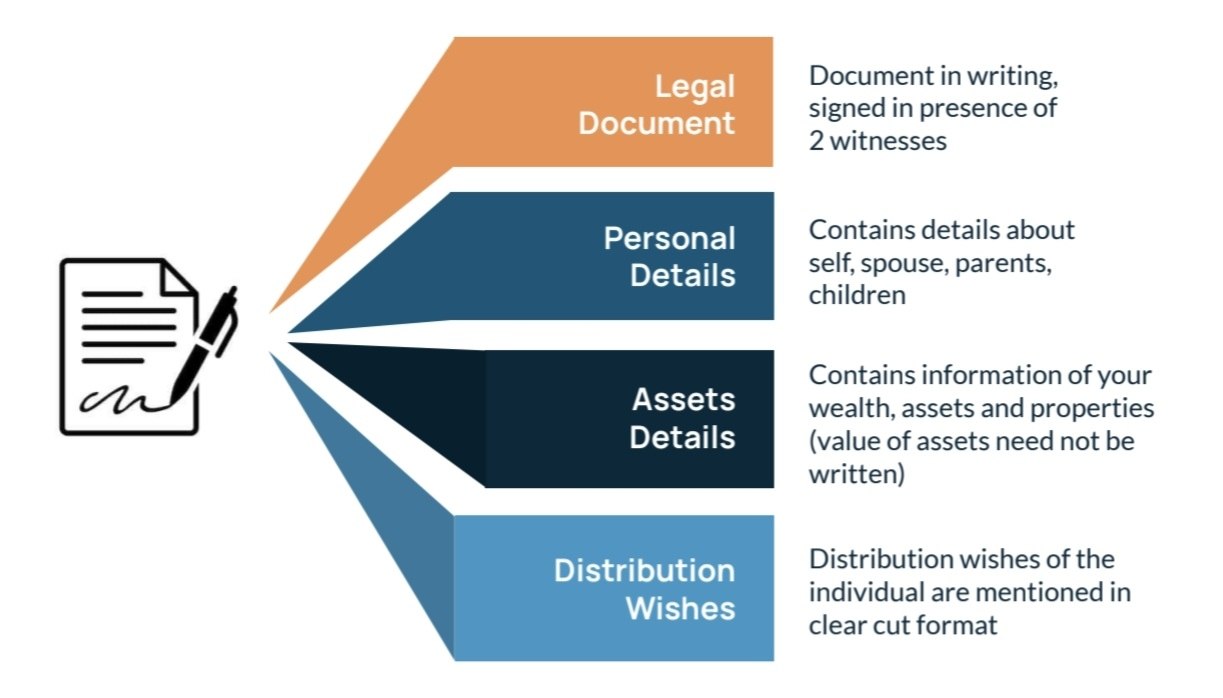
Four things:
- ✍️ Legal document: written and signed in the presence of two witnesses. Not verbal. Not on a napkin. Two witnesses.
- 👤 Personal details: information about yourself, your spouse, your parents, and your children.
- 🏠 Asset details: information about your wealth, assets, and properties. The value of assets does not need to be written — the description does.
- 📌 Distribution wishes: clear, unambiguous instructions on who gets what. Not “divide equally among everyone.” Specific names, specific assets.
That is it. Four components. No legal Latin required.
Will vs Family Trust: Which One Makes Sense?
🤷 Now, the part where people stop and ask: is a will enough, or should I set up a family trust?
They are not the same thing. They solve the same problem at different levels of robustness.
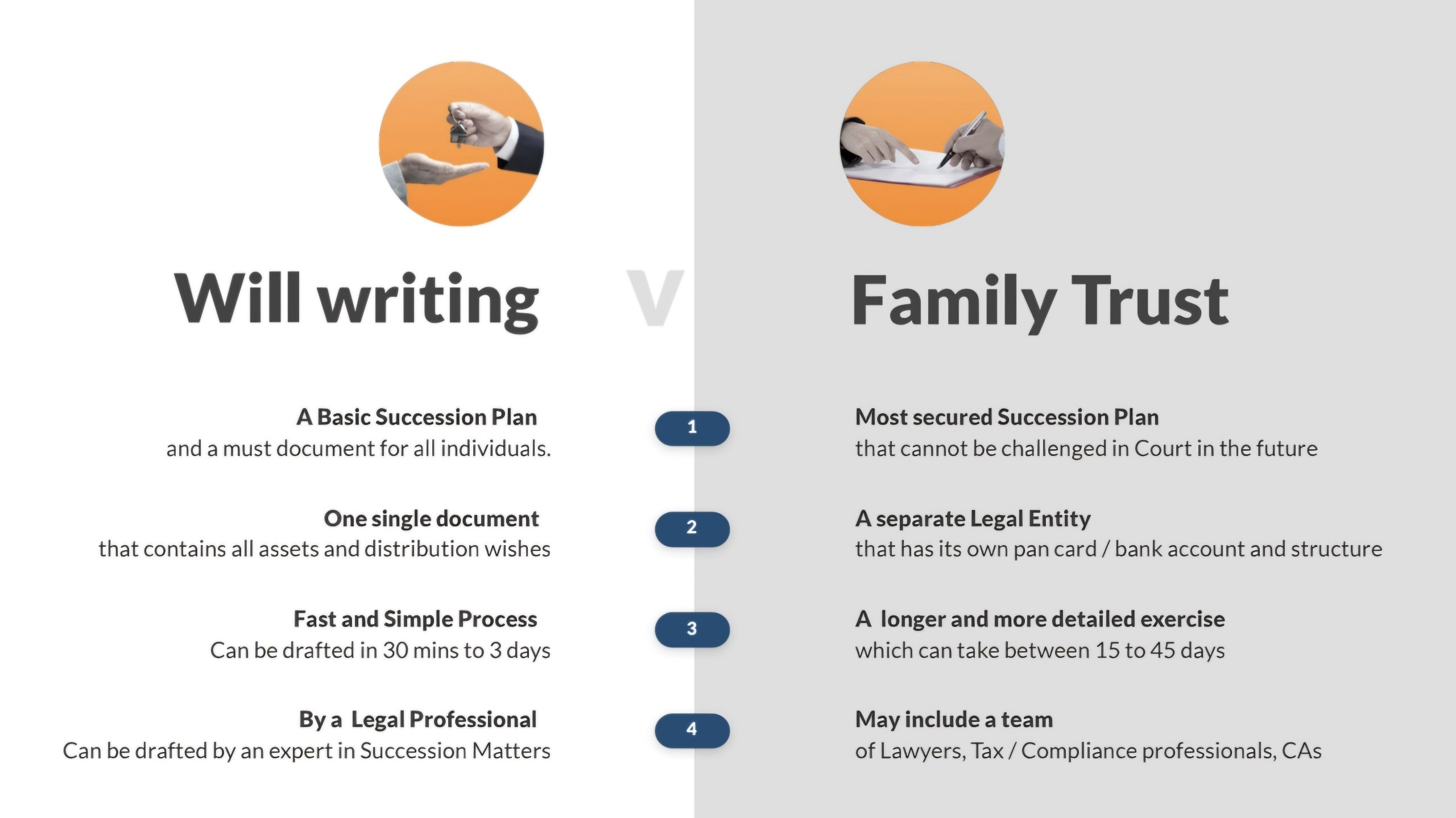
A will is a basic succession plan. One document. Contains all your assets and distribution wishes. Can be drafted in as little as 30 minutes to 3 days. Done by a legal professional or an expert in succession matters.
A family trust is a separate legal entity. It has its own PAN card, its own bank account, its own structure. It takes 15 to 45 days to set up. It may require a team — lawyers, tax and compliance professionals, CAs.
🔑 Here is the catch.
A will can be challenged in court. A family trust, when structured correctly, is far harder to challenge. The trust owns the assets, not the individual. The distribution happens according to the trust deed, not through probate.
For most people, a registered will is the right starting point. For families with substantial assets, complex ownership structures, or a history of disputes, a family trust is worth the extra effort.
Think of it this way: a will is the minimum viable protection. A trust is the maximum.
Documents Legal Heirs Actually Need
📄 Even with a will, the family will need documents. A will is the starting point, not the ending point.
The standard requirements:
- Death certificate (original or certified copy)
- Identity proof of the claimant
- Address proof of the claimant
- Copy of the will
- Probate order, if applicable
Different institutions — banks, mutual funds, insurers, property registration offices — may have their own specific protocols. The Moneycontrol report notes that “accurate documentation would not only expedite the process but could also avoid any potential problems leading to a rejection of your application.”
Missing one document can mean weeks of back-and-forth. Getting it right the first time matters.
The Fix Is Simpler Than the Problem
🎯 The entire problem — the confusion between nominee and heir, the family disputes, the frozen assets, the tax surprises on sale — most of it traces back to one missing document.
A registered will.
A well-drafted will records exactly who should receive what. It reduces ambiguity. It gives the family one document to follow instead of seven people fighting over one bank account. It does not eliminate every possible dispute, but it removes the most common ones.
This is not a small distinction.
A nomination is a quick fix. A will is a structural fix.
The quick fix says: “Hold this for now.” The structural fix says: “This is who owns it, and here is the proof.”
💭 My worry is not that people do not care about their family. They do.
My worry is that they think a form they filled in at a bank counter is a substitute for a will. It is not. It never was.
No?
What Primeidea Ventures Does
🤝 Primeidea Ventures provides structured support for will writing, will registration, and succession planning.
Not just a template. The actual process — drafting, witnessing, registration, and documentation support.
Because the gap between filling in a nominee form and writing a registered will is where most Indian families lose time, money, and peace of mind.
🛡️ Protect your nominee. Protect your family. Protect your legacy.
Connect with Primeidea Ventures to begin your succession planning today.
Visit https://www.primeidea.in
Frequently Asked Questions
Is a nominee the same as a legal heir?
No. The Supreme Court settled this in Shakti Yezdani vs Jayanand Salgaonkar (2023). A nominee is a trustee or custodian, not the absolute owner. The legal heir or beneficiary named in a valid will has the actual claim. If there is no will, distribution follows the applicable succession law.
Is probate still required after the 2025 amendment?
No, probate is no longer mandatory. The Repealing and Amending Act, 2025 omitted Section 213 of the Indian Succession Act, 1925. This applies even in Mumbai, Chennai, and Kolkata where it was previously compulsory. However, probate is still advisable in cases of family disputes, doubtful wills, or substantial assets.
Is there an inheritance tax in India?
No. India abolished inheritance tax in 1985. Section 56(2)(x) of the Income Tax Act exempts inherited assets from tax at the point of receipt. However, capital gains tax applies when you sell an inherited asset, and income from inherited assets (rent, dividends, interest) is taxable from the date of inheritance.
What documents are needed to claim assets through a will?
Death certificate, identity proof, address proof, copy of the will, and probate order if applicable. Institutions may have additional requirements depending on the asset type.
Can a nominee be challenged in court?
Yes. Other legal heirs can challenge the nominee’s claim, especially when there is no will or when the will is disputed. The Supreme Court has confirmed that nomination does not confer absolute ownership.
Which law applies to my inheritance if I die without a will?
It depends on your religion. Hindus, Sikhs, Jains, and Buddhists are governed by the Hindu Succession Act (1956, amended 2005). Indian Christians and Parsis fall under the Indian Succession Act (1925). Muslims are governed by Sharia law. Each has its own hierarchy of legal heirs and distribution rules.
Does a will override a nomination?
For most assets, a valid will takes precedence over a nomination. The nominee holds the asset in trust, but the will determines who the final beneficiary is. Having both — a nomination and a registered will — is the correct approach.