
Executive summary
 India is late to semiconductor manufacturing, but the important point for investors is clear: the ecosystem has started forming.
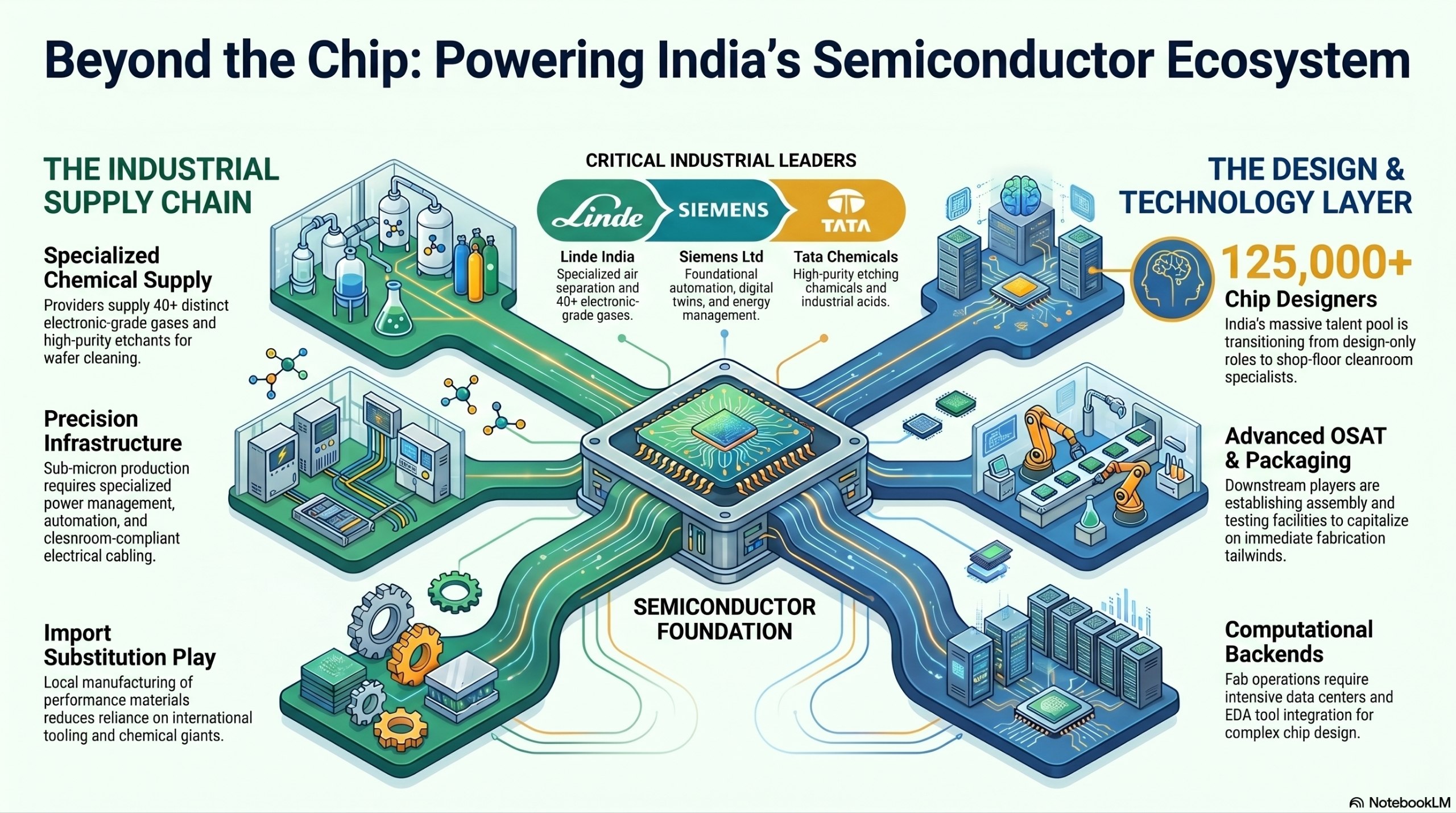
Tata’s ₹91,000 crore Dholera semiconductor fab is not only a chip plant. It can become an anchor for manufacturing talent, cleanroom discipline, specialty chemicals, high-purity gases, equipment partnerships, automation, power systems, chip design, packaging, testing, and downstream electronics.
This is how serious wealth-creation cycles begin. First comes policy support. Then anchor projects. Then suppliers, engineers, vendors, and listed businesses start aligning around the opportunity. The headline may be about chips, but the larger opportunity may come from the businesses that help the chip ecosystem function every day.
For investors, this is not a short-term trading theme. It is a portfolio-review moment. Equity investing is ultimately about owning businesses that can participate in long-term change. The right question is: Is your current equity and mutual fund basket aligned with India’s next technology and manufacturing evolution?
This article is not asking investors to chase semiconductor headlines. It is asking them to review whether their portfolio has the right exposure to quality businesses, future-facing sectors, and India’s next industrial cycle.
Why this matters now
India already has strong semiconductor design capability:
- 1,25,000+ chip designers
- around 20% of the global chip design workforce
- nearly 50% contribution to global chip-design value, according to the source material
- R&D presence from global leaders such as Intel, AMD, Qualcomm, and NVIDIA
- strong software, embedded systems, and engineering talent
But designing a chip and manufacturing a chip are different skills.
Design is the blueprint. Manufacturing is cleanroom execution, yield improvement, process control, and physical semiconductor discipline. India has design strength. Now it is trying to build manufacturing depth.
Why Dholera is important
The Tata semiconductor fab at Dholera can become an anchor project.
A fab does not work alone. It needs:
- cleanroom engineers
- specialty gas suppliers
- high-purity chemical companies
- equipment and maintenance partners
- power and automation providers
- testing and packaging players
- electronics manufacturers that may use domestic chips in final products
That is the real investor lesson.
The chip plant gets attention. But long-term value may also develop in the companies quietly supporting the plant every day.
India is building the talent base
The government has set a target to train 85,000 specialized semiconductor professionals over 10 years.
According to the source material, around 65,000 professionals have already been trained through curriculum changes, global exposure, and industry-linked programs.
Important signals:
- AICTE curriculum upgrades for VLSI and IC manufacturing
- EDA tools from Synopsys, Cadence, and Siemens made available to 35 universities
- 1.85 crore hours of chip-design training already logged
- Mohali’s SCL Lab, where student-designed chips can be fabricated and tested
- training exposure through global semiconductor hubs such as Taiwan and Singapore
- Lam Research’s virtual-twin training with IISc, aimed at reducing cleanroom training cost by around 40%
This matters because manufacturing knowledge cannot be created only through subsidy. It needs repeated execution, process discipline, and shop-floor learning.
Global equipment companies are entering India
Two developments stand out:
- Applied Materials has announced a $400 million innovation center in Bengaluru
- Lam Research has announced a ₹15,900 crore investment in Karnataka
These companies make the tools and systems that chip manufacturers need.
Their presence matters because fabs depend on process knowledge: maintenance, troubleshooting, yield improvement, and operational discipline.
India is still behind. But the direction is changing. This is similar to how mature semiconductor ecosystems developed globally: first the anchor fab comes, then equipment partners, process experts, vendor networks, and local technical knowledge start building around it.
Specialty chemicals: the hidden wealth-creation layer
A fab does not run only on silicon wafers and machines.
It needs:
- ultra-high-purity gases
- photoresists
- etchants
- cleaning chemicals
- CMP slurries
- wafer-processing materials
These are not ordinary industrial inputs. Semiconductor manufacturing works at extremely small dimensions. Even a tiny contamination issue can damage output.
That is why companies connected to specialty gases and high-purity chemicals become important. The source material highlights Linde India, Deepak Nitrite, and Tata Chemicals as companies moving toward this ecosystem.
Linde India is highlighted as setting up a dedicated Dholera plant to supply the Tata-PSMC fab, with more than 40 different gases and chemicals expected to support the manufacturing process. Once a fab qualifies a supplier, the relationship can become sticky because changing suppliers is difficult and costly.
Policy support and local IP are adding depth
The semiconductor story is also being supported by policy and local design ambition.
Important source-data points:
- Indian Semiconductor Mission 2.0 has been discussed with a proposed ₹1 lakh crore allocation
- Design-Linked Incentive support has been increased from ₹1,500 crore to ₹5,000 crore, a 233% jump
- the stated target is to support 50 fabless startups
- 24 chip-design projects have already been approved
- 16 tape-outs have been completed
- Indian-designed chips at 12-nanometer have begun physical fabrication globally
This matters because India should not only assemble technology. Over time, the stronger wealth-creation opportunity can come when local companies participate in design, IP, manufacturing support, packaging, testing, and final electronics.
The source material also mentions CP Plus working with an L&T chip-design unit for chips that can eventually be used in CCTV cameras. Another future-facing signal is the proposed Silicon Carbide fab in Odisha, targeted for 2028, with relevance for EVs and renewable-energy applications.
Where investors should focus
Investors should not chase every company that uses the word “semiconductor”.
Study the ecosystem in layers:
- Manufacturing anchors
Fabs, OSAT facilities, packaging units, compound semiconductor projects, and future Silicon Carbide capacity. - Specialty chemicals and gases
Electronic-grade gases, etchants, cleaning chemicals, and high-purity materials. - Power, automation, and infrastructure
Fabs need uninterrupted power, cleanroom controls, cabling, water systems, and backup infrastructure. - Design and technology
Chip design, embedded systems, EDA support, data centers, testing, tape-outs, and domestic IP. - Downstream electronics
EMS and packaging companies can benefit if Indian chips move into cameras, EV components, telecom hardware, industrial devices, and consumer electronics.
Study areas for portfolio review
These names are useful study areas when reviewing portfolio exposure to this theme.
Large-cap ecosystem names
- Linde India, Tata Chemicals, Siemens, ABB India, LTIMindtree
Mid-cap ecosystem names
- Deepak Nitrite, Dixon Technologies, KPIT Technologies, Polycab India, Tata Elxsi
Emerging niche names
- Anupam Rasayan, Aether Industries, Clean Science and Technology, Techno Electric, Schneider Electric Infrastructure, Kaynes Technology
Before adding exposure, investors should check actual semiconductor-linked revenue, valuations, debt levels, execution capability, and order visibility.
The real portfolio question
India may not become Taiwan tomorrow. But that is not the point.
The real question is whether India is moving from technology consumption to technology creation.
The Dholera fab, training programs, global equipment-company investments, specialty chemicals, design incentives, and downstream electronics opportunity all suggest that India’s next business evolution has started.
India still imports nearly 5 crore chips every day, according to the source material. That number explains why this theme is strategically important. Even partial localization across design, packaging, chemicals, gases, equipment support, and downstream electronics can create a broader business opportunity over many years.
For investors, this is the right time to ask:
- Is my portfolio still built around yesterday’s winners?
- Do my equity and mutual fund baskets reflect India’s next manufacturing and technology cycle?
- Am I missing businesses that can benefit from long-term industrial compounding?
- Is my portfolio designed only for capital gains, or for serious wealth creation?
Review your portfolio before the trend becomes obvious
Equity investment is about buying into businesses.
If India’s technology and manufacturing ecosystem is changing, portfolios also need to be reviewed with that lens.
At Primeidea, we help investors review their existing equity and mutual fund baskets to check whether they are aligned with upcoming business trends, wealth-creation opportunities, and long-term portfolio discipline.
A portfolio review can help you assess whether your holdings are aligned with India’s next growth cycle, whether your mutual funds are positioned for future themes, and whether your equity basket needs rebalancing for long-term wealth creation.
Connect with us for a portfolio review.
India may be late to semiconductors. But the evolution has started. The bigger question is whether your portfolio is ready for it.