






TL;DR
Foreign investors are pulling money out of overheated markets in South Korea and Taiwan. India now looks more attractive on valuation, but high crude oil prices remain the main obstacle to a stronger and more sustained return of foreign capital.
Key Takeaways
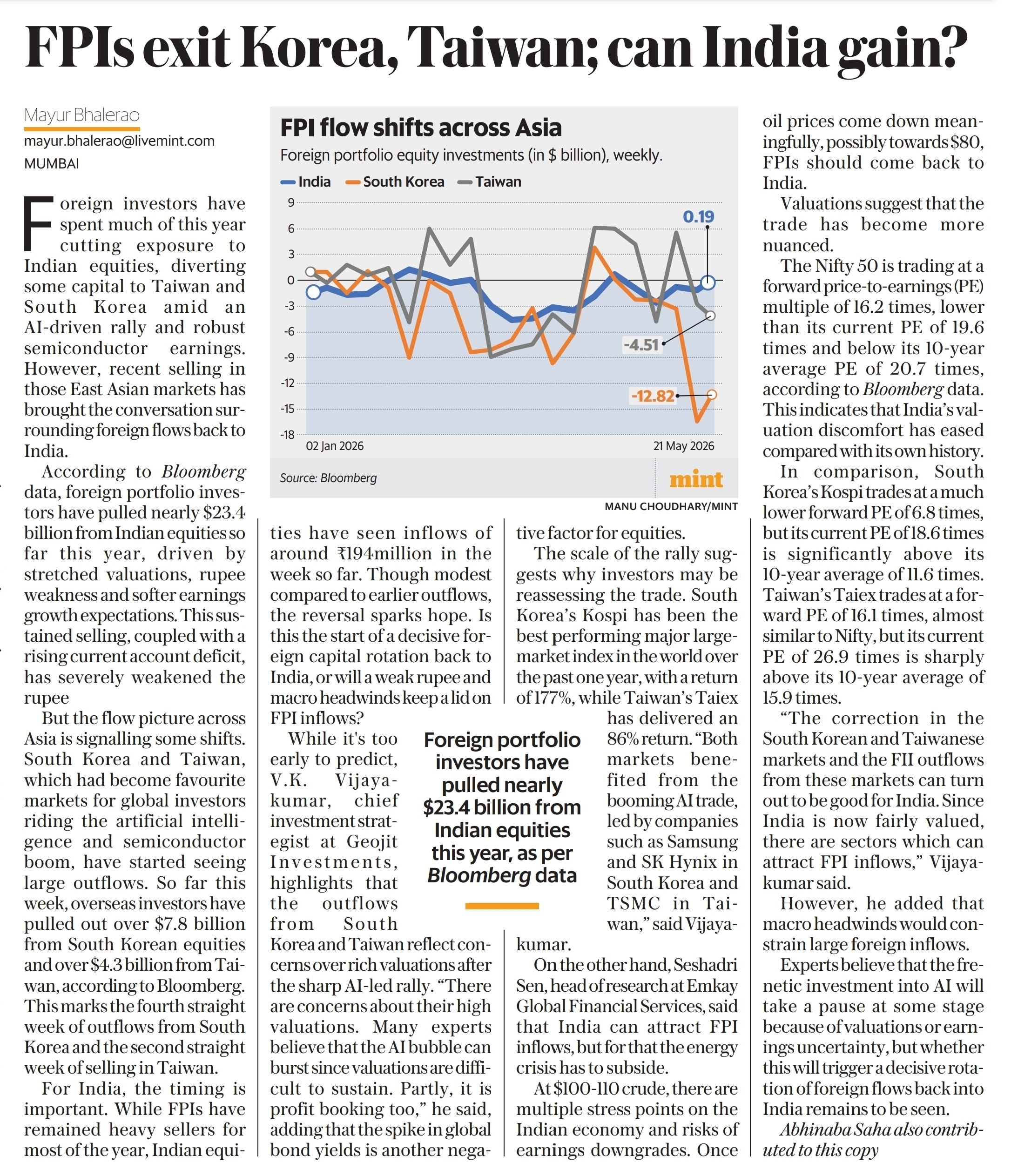
- Foreign investors pulled more than $7.8 billion from South Korea and over $4.3 billion from Taiwan in one week as valuations became stretched.
- India saw heavy foreign selling earlier this year, but a small inflow of about $194 million suggests sentiment may be starting to stabilise.
- The Nifty 50 forward PE is around 16.2 times, below its 10-year average of 20.7 times, which improves India’s relative valuation case.
- Any sustained return of foreign flows to India will depend not just on lower valuations, but also on crude oil prices easing closer to $80 a barrel.
Detailed Breakdown
Foreign portfolio investor flows across Asia may be starting to shift again. After chasing the artificial intelligence-driven rally in South Korea and Taiwan, global investors are now pulling money out of both markets as valuations look increasingly stretched. That raises an obvious question for Indian investors: can India benefit from this change in direction?
The case is not straightforward, but India is beginning to look more attractive than it did a few months ago. Valuations have cooled, foreign selling has slowed, and early signs of fresh inflows are starting to appear. Even so, one major risk remains in the background: high crude oil prices.
Why are foreign investors pulling out of South Korea and Taiwan?
The trigger appears to be valuation fatigue after a sharp rally led by AI and semiconductor stocks. In a single week, foreign investors pulled more than $7.8 billion from South Korea and over $4.3 billion from Taiwan. When such large moves happen in a short period, they usually point to profit booking and a reassessment of how much upside is still left.
Both markets had enjoyed strong momentum, but that momentum also pushed valuations well above their long-term averages. Once that happens, global funds often start looking for markets where growth expectations are still reasonable but pricing is less demanding.
Where does India stand now?
India looks relatively better placed on valuation. The Nifty 50 forward PE is around 16.2 times, which is below its 10-year average of 20.7 times. That is a meaningful reset from the stretched levels that had earlier made Indian equities look expensive in comparison with other Asian markets.
This matters because foreign capital rarely moves on headlines alone. It usually looks for a mix of earnings visibility, macro stability, and sensible valuations. On that front, India is no longer under the same valuation pressure it was facing earlier in the year.
What changed after the earlier FPI sell-off in India?
Foreign investors had pulled nearly $23.4 billion out of Indian equities earlier this year. That selling was driven by expensive valuations, weaker earnings momentum, pressure on the rupee, and concerns around the current account deficit.
Now, the tone appears to be softening. India has seen a modest weekly inflow of about $194 million. It is too early to call this a full reversal, but it does suggest that global investors are beginning to revisit India as relative opportunities change across the region.
What could stop foreign capital from returning in a bigger way?
The biggest risk is crude oil. Analysts have noted that oil in the $100 to $110 range creates stress for the Indian economy through inflation, the current account, and corporate margins. So even if equities look cheaper, the macro environment can still keep foreign investors cautious.
That is why lower valuations alone may not be enough. A more durable return of foreign money into India may require crude prices to cool closer to $80 a barrel. That would make the India story more comfortable from both a valuation and macro perspective.
Conclusions
India has a genuine opening. South Korea and Taiwan are dealing with the after-effects of an overheated rally, while Indian valuations have become more reasonable. If oil prices ease and earnings remain stable, India could attract a larger share of foreign flows in the next phase.
For now, the setup is improving, but the return of foreign capital is still conditional. Valuation helps, but macro stability will decide whether this shift becomes meaningful.
Source: Mint, “FPIs exit Korea, Taiwan; can India gain?” and the accompanying market data referenced in the article image provided by Partha.